Saturday, 24 March 2012

Me and my manly scooter...


I am now two weeks into my time in China, and feel it is definitely time to finish sharing my adventures from India! China has been a great experience so far – I have been incredibly lucky to meet some absolutely amazing people, on a range of trips and adventures, for reasons ranging from a short trip away from work, to years of backpacking in an attempt to escape the monotony and boredom of everyday life back home. The weather is getting colder the further north I head, and this morning I am writing from a McDonalds restaurant in Beijing – I travelled overnight and attempted to catch the subway to my hostel – however it turns out when you are over 6ft tall, broader than three Chinese commuters put together, and carrying a large backpack, the crush of peak hour pedestrians is not the easiest or most accommodating of places to be!

Kerala - "God's Own Country"
Leaving Auroville, I spent a day enjoying the French provincial architecture and parks of Puducherry (formerly Pondicherry), before boarding an over-night bus to Kerala, a coastal state in southwest India, and very highly promoted as ‘God’s Own Country’ – which after 6 weeks in the pollution, over-crowding and poverty of India, was a marketing strategy I was going to wait to see to believe.

Varkala Beach
My first stop in Kerala was Varkala, a budget tourist beach resort, set high on a cliff overlooking the black and grey sands of the beach below. The resort precariously follows the shape of the cliff, and is lined with dozens of similar restaurants, serving a range of sensational Indian foods, and some downright terrible attempts at western dishes. I spent hours people-watching, and quite quickly realised that a typical day in the life of a Varkala tourist consists of waking up mid-morning, hung-over and peeling from previous days of sunburn, before sitting down without any sun protection, in the full sun, outside a restaurant to watch the world go by, and ease the hangover with a greasy late-breakfast and fresh orange juice. With the greasy breakfast now devoured, the typically overweight-yet-still-wearing-budgie-smugglers-or-bikinis-in-public tourists then wander the many shops and market-stalls (still dressed in their revealing-best!), on the look out for yet another cheap, loud, and revealing shirt or sarong in which to wear on the beach in the afternoon’s full sun. Failing to find something hideous or inappropriate enough for public view, the typical Varkala tourist then drops back into their accommodation to re-apply copious amounts of tanning lotion, re-grease their greying mullet, collect their bug-eyed sunglasses in order to achieve the prefect facial-tan-line, and then head down to the blistering hot sand, in the middle of the scorching heat of the day, to sunbake for the afternoon, while their under-paid hired waiters run up and down the steps to the beach, fetching food, drinks, and no doubt more hair-grease in which to maintain the tourists image for the afternoon. Following an afternoon of dermatological-murder, with skin peeling in the same pattern as a Woolworths tiger loaf, the typical tourist then heads back up the cliff, to relieve their incredibly dehydrated and burnt bodies with excessive consumption of Kingfisher beer or cheap spirits, before settling into yet another restaurant to watch the sunset, tuck into an excessively sized dinner banquet, before ending the night with a few more beers to rehydrate their bodies ready for the same treatment tomorrow. As you can tell, I fit right in!

Trashy, middle-aged, overweight, bogan tourists aside, I did actually have a great time in Varkala. On realising I was probably not going to enjoy three days spent lazing around the resort, I hired yet another motorbike (okay, it was actually a scooter this time, but that doesn’t sound as hardcore!), and went in search of the real Kerala. Riding just two hours out of town, I began to realise why Kerala is called ‘God’s Own Country’, as the hustle, pollution and tourism of Varkala opened up into some of the most untouched, beautiful scenery I had seen in India. White, pristine beaches stretched as far as the eye could see, broken up every now and then with yet another palm-tree lined canal or waterway snaking it’s way to the ocean. The coast was scattered with small, quaint fishing communities, with canoes and boats upturned on the pollution-free sand (I know, I couldn’t even believe it myself!), and tree after tree of hand woven fishing nets, hanging down to dry, as the days catch was left to dry in the sun below. As I rode through communities sometimes consisting of just a couple of weathered structures, faded in the blistering sun, I was greeted by countless fishermen and locals – seemingly oblivious to the fact I was a tourist – with a wave, a local greeting and a smile. This wasn’t the India I was used to!

Blown away by the beauty of the Kerala backwaters, the friendly, kind and caring locals, and the dramatic contrast between the beach resort in which I was staying, and the local communities just kilometres down the road, I thought my adventures couldn’t get any better. Then school finished. Throughout my travels in both India and Nepal, I had been incredibly impressed with the immaculate dress, behaviour and attitude of all the school students I had come across (a great difference to the public behaviour of students back in Australia!) however what happened next, on my manly, butch scooter in a small town I don’t even know the name of, was truly unforgettable. Riding leisurely into the town – the main street following the path of one of the magnificent tree-lined backwaters – I was greeted by a street filled with 100 or so parents and students, obviously walking home from the local school. As I got closer to the group, I was quite amused when a couple of students who had seen me, stepped out onto the road, with their hands out ready for a high five. Of course, not wanting to disappoint these kids, and feeling relatively confident at taking one hand off the handlebars, I reached out and gave the kids a high five, much to their obvious delight, and quite loud cheering. Not surprisingly, this cheering attracted the attention of the rest of the group, and within seconds, I found myself faced with a whole street of children, holding their hands out into the street, as their parents watched on with a look of great excitement. By this stage more confident at riding one-handed, I rode the entire stretch of the main street, high fiving countless kids as I went, followed the whole way by shouts and cheers from the students, and sporting a smile broader than I thought possible.

The Kerala Backwaters
Just out of town...
I spent three nights in Varkala, riding my scooter for a couple of hours each day out into the countryside, and walking the beach and resort at night time (where I unexpectedly bumped into the famed Harriet from Hahndorf!). I don’t know what I was expecting from a beach resort in a country where a woman cannot show her shoulder without being chastised by her community, let alone wear a bathing suit, and where the local police have to patrol the beach to stop local men participating in lewd acts while watching female tourists walk the beach below… but I do know what I ended up with. I ended up with an adventure into towns and communities where tourists rarely go, where I was warmly welcomed because I was a human being, and not because of the tourist dollar in my pocket, and most importantly, I ended up with an unforgettable few days amongst some of the most beautiful scenery the world has to offer. I spent hours wishing more tourists would make the effort to hire a bike and see some of what Kerala really has to offer (I only bumped into two tourists in my three days of exploring), yet I spent an equal amount of time realising my experience was only magical because the people and places I went were not filled with the typical tourist crowd.

Jeeping it on the look out
for a Tiger!
From Varkala, I headed toward the mountains, stopping overnight in Alleppey to explore the backwaters in a canoe, before making my through rolling hills, filled with rubber and tea plantations, to Kumily – a bustling town on the edge of the Periyar National Park. The Periyar National Park is famous for its booming wild tiger and elephant populations, and as I have since discovered, is almost as famous for the boat tragedy which claimed 45 tourists lives in 2009 – a fact they didn’t happen to mention when I was booking my boat trip inside the park! I spent my first day walking the breath-taking tea and spice plantations of the region, learning about the importance and many uses of spices and tea as herbal medicines in Indian culture. I booked myself on a sensational tour at a local plantation, and was enthralled with all the uses of the spices, however promptly forgot everything the second I stepped out of the gate! With limited time in Kumily, and minimal information in the Lonely Planet guide, I booked a wildlife tour through my guest house, and woke the next morning at 4.30am to head into the jungle in a Jeep – a rather cold journey at this time of the morning in the Indian mountains, but an interesting journey nonetheless, as the driver turned up the music, and we drove through the morning fog with Backstreet Boys, Enrique and Shakira blasting through the speakers. I met some brilliant, interesting people in the Jeep, however the tour was terrible, and has to be the most disappointing days of my time in India. We saw 3 monkeys, a bison, and a lot of ‘elephant footprints’, which looked to me like squashed leaves. I understand seeing animals in the wild is very much luck of the draw, however the rest of the tour was a joke – we spent hours filling time between boring activities, and to top it off, the day was probably the most expensive of my travels to date. Remind me not to do that one again!!!

I took a ride in a Ferrari!!!
Heading back down from the mountains (a 180km trip which took seven hours!), I made my way to Fort Kochi (formerly Cochin), a small fishing village occupied by the Portuguese in the 16th century, and now a busy tourist town, set on the banks of one of Kerala’s many polluted waterways. My last couple of days in India were spent strolling the streets and shops of the fort (I bought too much and had to ship it home!), watching local fishermen use ancient shore-based counterweighted Chinese fishing nets, to hoist their daily catch from the murky, polluted water of Kochi’s rivers, and spent my last day contracting a rather unpleasant bout of ‘Delhi Belly’ – which I was then fortunate to be able to carry with me on my next 13 hours of flights, and the 12 hour stopover at KL low cost terminal – more a garden shed with filthy tiled floor than what I would usually refer to as a terminal. As you can imagine, a pleasant journey to China!


Thursday, 22 March 2012

Statistics are so much fun!

I’ve spoilt myself! Today’s blog entry should take on a more relaxed, ‘less likely to be robbed at any stage’ feel, and my Mac screen should also enjoy this passive smoking free – and therefore cough and spit-free – entry greatly, as I am currently smoothly speeding through the north of China, smoke and pollution free (this carriage actually has windows and relatively clean air!!!) on a first-class high-speed sleeper train from Xi’an to Beijing. Unfortunately I am paying for this kind of luxury – the hard sleeper trains were all sold out – however it is a nice change from the typical backpacker transport of India, Nepal and China.

Tuesday marked two months of travel, and as I continue to head north (toward -30° weather in Mongolia!), I think I am finally beginning to realise what an adventure I have managed to get myself into – I am only ⅙ of the way through my journey, yet I feel I have learnt more, and experienced more than I should be entitled to in a lifetime! The people I have met along the way, the opportunities and experiences I have had, and the impact these have had on my life make me feel incredibly lucky, yet make me realise how much my life will change in a year abroad, and how much of a challenge I face next January, when I have to face reality, and head back to life in Australia. I have spent countless hours standing in front of tourist sites, natural wonders, and even the mundane moments of everyday life in a foreign country, and found myself wishing there was some way I could capture the beauty, magnificence and true essence of travel, and somehow find a way to capture this, and take it home to share. Unfortunately, I have realised that no matter how impressive the megapixels on my camera, how many facebook statuses I make, and how much I talk and type, there never will be a way to accurately share my experiences with those at home – however, I do thank you all for reading this blog, and sharing in my travels so far!

This week also marks another milestone in my travels, as this blog has reached 3000 page views since I left home! I have made some small changes to the format as I have worked out what works, and what doesn’t work in the world of blogging (a world I have never entered before!), and have hopefully come up with a blog that is at least somewhat user-friendly. Let me know if you disagree! I will continue to change the background and colour scheme as I make my way through different countries, however other than these cosmetic changes, things should stay the same.

I have decided this is also a good opportunity to share some statistics about the blog, which I am lucky enough to be able to view along the way, and I have certainly found interesting to keep an eye on! Please note, my own access of this blog is NOT recorded in any of these statistics, so they should be a fair indication of who is dropping in to say hi.

Total page views to 22.03.12
3002   views


Total word count to date 22.03.12
20156   words


Page views by country (Top 10)
Australia – 2138 (71.0%)
United States – 317 (10.0%)
India – 170  (6.0%)
United Kingdom – 97  (3.0%)
New Zealand – 66  (2.2%)
Germany – 38  (1.3%)
Nepal – 36  (1.2%)
Malaysia – 28  (0.9%)
Russia – 20  (0.5%)
Turkey – 13  (0.4%)


Page views by browser (Top 5)
Internet Explorer – 929   (31%)
Safari – 850   (28%)
Google Chrome – 513   (17%)
Firefox – 328   (10%)
Mobile Safari – 277    (9%)


Page views by operating system (Top 5)
Windows – 1559   (54%)
Mac – 609   (21%)
Android – 283    (9%)
iPad – 182    (6%)
iPhone – 167    (5%)


Page views by blog entry (Top 3)
I love my Mum… bai!
235 views

“It feels the same… it’s just yours is so funny looking!”
201 views

It’s not about the money, money, money!
144 views

Wednesday, 14 March 2012

Auroville - A youth that never ages.

I write this morning from a brand new, clean, smooth and comfortable high-speed train, hurtling at around 240km/hr between Shanghai and Wuhan, China. Quite the change from the public transport of India!!! In fact, my time in China has been a DRASTIC change from my time in India and Nepal, with clean, livestock free roads and footpaths, an extensive and fast public transport network, functioning waste disposal system, closed sewers, and a noticeable lack of rickshaw drivers and taxi drivers trying to rip me off on every street corner. To top things off… my hostel even had hot water… and a REAL PILLOW!!! But, more on China in a later post, there’s still plenty more of my adventure in India we are yet to cover...

Being a budget conscious traveller (and just cheap and nasty), I was thrilled when Anna and Rasmus told me they were heading to Auroville on my last day with them, and I was welcome to join them for the drive. Auroville (which I had never heard of, nor planned to travel to until they mentioned it!) is a township located about 25km out of Puducherry (formerly Pondicherry), near the east coast of India. According to the Auroville guide…
"Auroville wants to be a universal town where men and women of all countries are able to live in peace and progressive harmony above all creeds, all politics and all nationalities. The purpose of Auroville is to realise human unity."
A round-about... with  a car!
Sounded interesting, if nothing else. Driving into Auroville, my first impression (after I had managed to get over the shock there was no litter on the streets!) was I had just found my way into some weird hippy cult. I found myself in a town located amongst a recently cyclone ravaged strip of vegetation, almost cut off from the outside world, where western ‘hippies’ and ‘tree-people’ rode motorbikes in thongs (that’s the shoe-form of thong, thank goodness!), wore felt and cheesecloth clothing (after the favoured hessian of course!), and children ran barefoot through the paddocks, flying kites and hunting for bugs to pass the time. Even more startling to me was the centre of the town, where a large, flattened gold golf ball was apparently the town temple, attracting stares, camera lenses and hoards of tourists, while the nearby tourist information centre sold hand-made writing paper, India’s version of gum-nut earrings, and organic ice-creams in flavours like butter-scotch jaggery and honey guava. Where on Earth was I?

The Matrimandir
Set up in 1968 by a French woman and an Indian man (who had completed his studies in Europe), the initial settlement of Auroville consisted of people from 124 different nations, with the significance of this ‘global community’ celebrated with a handful of soil from each of these nations being placed in a large urn, which is now the central focal point of the amphitheatre I was later luckily enough to get to experience. With the creation of this new community, came the creation of a community charter, which outlines the vision and direction of Auroville, as a community for all human people.
  1. Auroville belongs to nobody in particular. 
Auroville belongs to humanity as a whole. 
But to live in Auroville, one must be a willing servitor of the Divine Consciousness.
  2. Auroville will be the place of an unending education, 
of constant progress, and a youth that never ages.
  3. Auroville wants to be the bridge between the past and the future. Taking advantage of all discoveries from without and from within, Auroville will boldly spring towards future realisations.
  4. Auroville will be a site of material and spiritual researches for a living embodiment of an actual Human Unity.
At the centre of the township is the round ‘peace area’, which includes the large amphitheatre, a massive, beautiful banyan tree, a range of yet-to-be-completed gardens, and a huge, gold-golf-ball looking structure, called the Matrimandir. In Sanskrit, this translates to Temple of The Mother, however the temple itself has no religious connection, but is rather a place of personal spiritual significance. The building is undoubtedly unique – taking 37 years to complete – is covered by over 1415 gold disks, and is surrounded by 12 ‘petals’, or meditation rooms, each dedicated to one of the ideas the people of Auroville strive toward – existence, consciousness, bliss, light, life, power, wealth, utility, progress, youth, harmony and perfection. As the development of the peace area continues, these petals will then continue outward, into gardens, with one flower dedicated to each of these 12 ideas, and eventually a body of water, which will surround the whole area. Beneath the huge suspended ‘golf-ball’, a lotus flower shaped fountain gently flows toward a central beam of sunlight, seen throughout the inside of the structure.

Although it has a tourist information centre, Auroville is not really set up as a tourist destination, and the Matrimandir is not open to the general public. However, it turns out I am rather lucky, and because Anna and Rasmus knew a couple of people in Auroville who were with us, I was with ‘locals’, and therefore I was allowed inside! Some people wait for weeks, and travel great distances for an invite inside, yet there I was, having only heard of Auroville the day before, walking straight past the hoards of unhappy tourists enjoying their view from a distance outside, straight into this amazing, one-of-a-kind structure. On entering, we were asked to leave our shoes outside, were each given a pair of ‘risky-business’ socks, and walked in silence, with no idea of what might lay ahead.

Inside the structure is like something completely from another planet! Staircases lead from the noise of the outside world, up through the base of the structure to a series of small, white marble rooms with windows overlooking the fountain below. These rooms lead to another set of stairs, cork-screwing up inside the inner chamber of the Matrimandir, into a huge, simplistic and modern round chamber, with pristine white carpeted floors, white marble stonework, opaque, orange glass walls, and small gold channels of water cascading down slanting pillars at intervals around the chamber. A beam of sunlight shines directly down through the centre of the building, as two sweeping, marble and glass ramps curve upward, passing through large marble columns, following the shape of the glowing interior walls, as they make their way higher within the structure. On reaching the top half of the structure, the ramps meet large white doors, leading into the upper chamber of the building. Inside this upper chamber is a 1100kg solid crystal globe, imported from Germany, and the focal point of the beam of light which shines throughout the layers of the building, and the centrepiece of the upper chamber. The interior of the upper chamber is a stark contrast to the orange glow of the chamber below. Everything is white. The walls, carpets, ceiling, columns, doors and floor cushions are all completely white, illuminated only by the glow of the crystal, and the beam of light which shines like a pillar through the centre of the chamber. Evenly spaced around the walls are 72 cushions – individual space in which we sat in silent reflection for half an hour, interrupted only by the occasional cough, reverberated around the circular walls.

From the Matrimandir, Nicole and Saatchi kept us busy for the day, seeing the sights of Auroville (3 of us on each motorbike of course!), answering our endless questions about the Matrimandir, life in India, and the seemingly thrilling everyday lives of the people of this small community. Our afternoon was one I will certainly never forget, as we made a spontaneous visit to ‘Fertile’, an organic farm/community/whatever in the green-belt area surrounding the city – and the owner of this strange place, an ex-pat Aussie called Johnny.

Johnny and his BBQ
If you were to judge a book by it’s cover, Johnny is a well-worn, yellow-paged, creased and crumpled paperback, left out in the elements to weather, deprived of a librarians TLC, and no doubt destined to end up collecting dust on the rickety shelf of the local second hand book store. Once you get Johnny talking however, you discover a craftily written international bestseller, a historical masterpiece, and a modern day drama all wound into one. With captivating history, intertwining plotlines, gripping stories, and one of those irritating endings where you are desperate to find out what happens – Johnny is certainly one of a kind. A self-confessed hippy, Johnny grew up in Sydney, and travelled extensively throughout Australia in the late 1960’s. In 1971, he ‘ran away’ from Australia, found himself in India, set up his amazing green-belt property, and never moved back.

The ‘green-belt’, according to the Auroville plan.
"The city area with a radius of 1.25 km. will be surrounded by a Green Belt of 1.25 km width. As a zone for organic farms, dairies, orchards, forests, and wildlife areas, this belt will act as a barrier against urban encroachment, provide a variety of habitats for wildlife, and serve as a source for food, timber, medicines etc. and as a place for recreation."
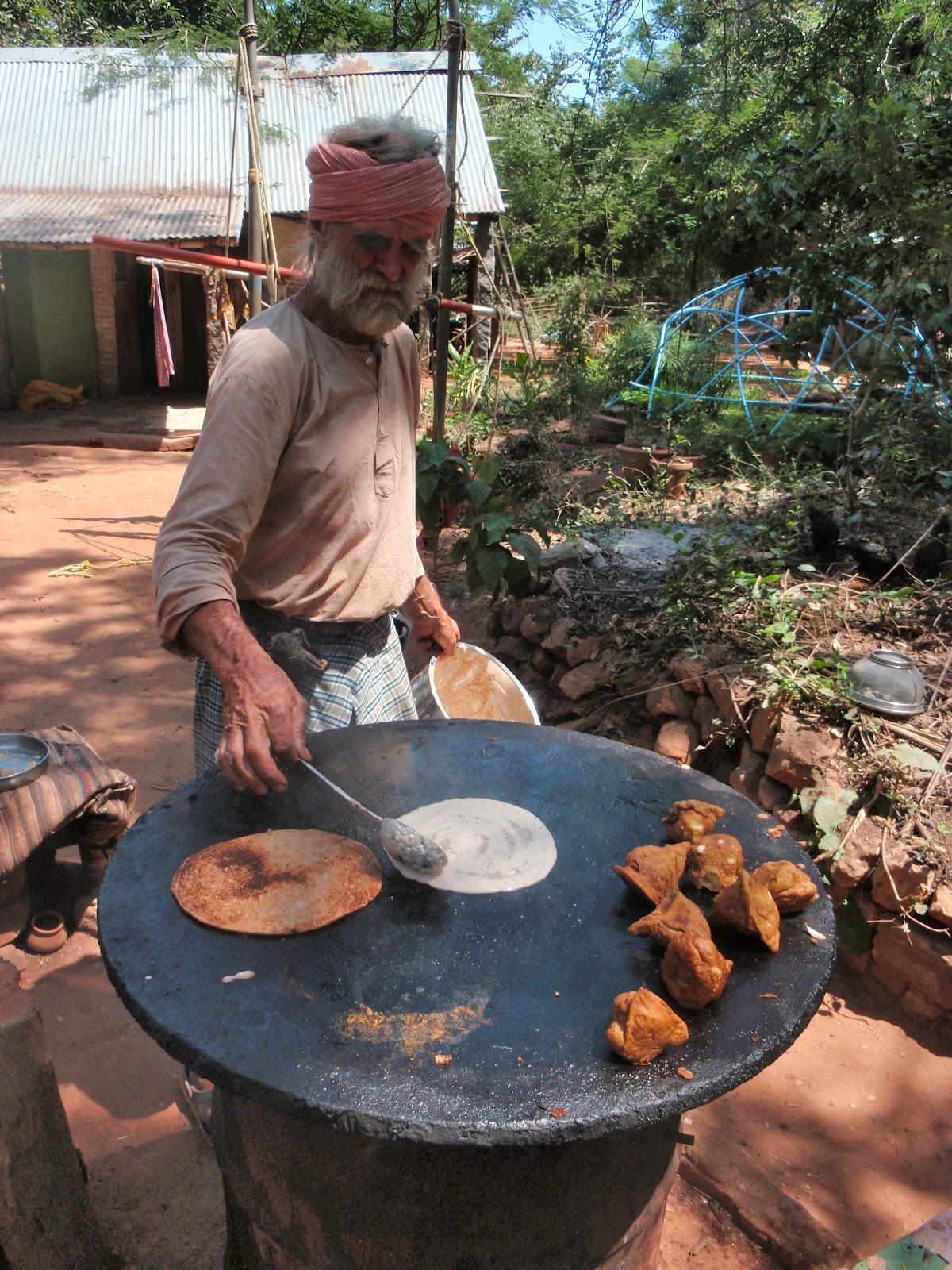
‘Fertile’, home to Johnny and anyone else who cares to set up camp at the time, is what Auroville is all about. It’s about working toward creating a better world. As a basic summary, it is an environmentally friendly, organic farm, built through many years of hard work, backbreaking labour, and a desire to create something special from previously abandoned and poorly maintained agricultural land. However, over 40 years after Fertile was created, it is now so much more. Through a focus on returning the land to it’s original condition, the introduction of permaculture and sustainable agriculture, over the last 40 years, the property has been transformed from a barren wasteland, into a developed, dense, ecological wonderland, with organic crops of cashews and millet, an outdoor ‘classroom’ for students of the local school, and an abundance of wildlife living in the now developed and towering trees (including humans!).

The property is accessed by motorbike, along narrow, winding, dirt tracks (rather uncomfortable with 3 of us to a bike!), and is an eclectic mix of buildings, shelters, structures and artwork, all surrounded by the hanging roots of overhead banyan trees, rope swings, tree house ladders and the towering vegetation. There is now a ‘traditional’ house on the property, which we were lucky enough to walk through, and definitely decided Auroville’s idea of traditional is far from that of ours in Australia! The front door of the house is a large, round, wrought iron swinging artwork, through which you find the kitchen – a series of archways, joined together with benches and appliances. The rest of the house continues to amaze, taking open-plan to new levels (there are rooms with whole walls missing!), and a bookcase along the passageway, with shelves that double as the staircase to the level above. Upstairs, all four walls are glass, providing a 360° view of the surrounding green-belt. Amazing! The other ‘buildings’ vary from a quaint, steep-roofed cottage, lined from floor to ceiling with overflowing bookshelves, basic huts built from mud and sticks, tree houses complete with mosquito nets and sharp palm fronds to keep the bats out at night, and the open communal kitchen, a large thatched roofed structure, obviously also a favourite spot for the chickens to hang out during the day.

The Front Door
We spent our afternoon wandering through the property with Johnny, stopping to learn about local plant species, the cashew trees, millet, the importance of an ‘unending education’, and the role all Aurovillians play in making this a reality. Coming from a country where a ‘good education’ is studying from books or Encarta in primary school, wearing a blazer and attending Ignatius in high school, and following it up with a stock-standard degree from a useless University, it was incredibly interesting to compare my own view with that of the people I met in Auroville. One day a week is spent learning on the land, or in the community, and EVERYONE is a teacher. Every single resident I spoke to, among other jobs they may have in the community, explained their job as being a teacher in one way or another – imagine that in Australia, if parents actually held themselves somewhat responsible for their kids education, and the future of the community. Woah! Let’s not get ridiculous here.

My HERO!
My second day in Auroville, I decided to hire a motorbike. I would guess 98% of transport in Auroville is done on bike, and I thought I should probably join the crowd. Asking a kid at the local corner store where I might hire a motorbike on a Sunday, I was rather amused when he opened a window, shouted something upstairs to his dad in Tamil, waited for a reply, then turned to me and said, “You can use one of ours if you like”. Unwilling to use their bike without some sort of payment, and knowing that the usual price in India is around 350 rupee/day (exl fuel), I thought I would be generous and offered them 100 rupee ($2). Deal – and he filled it up with fuel for me!!! Now, this was not just any motorbike – it was a Honda Hero. My Hero. With the man’s whole family now standing outside the house wishing me well, and me having not ridden a motorbike since I was probably about 12 years old, the pressure was on me not to stuff up too badly! Climbing on, trying desperately to remember what does what, and when it does it, I managed to find neutral, kick start the engine… and my hero roared into life! Struggling to actually fit my hiking boots on the foot-rests, let alone change gears, I finally found first gear… and slowly began to rev the engine. Gracefully releasing the clutch… the bike took off perfectly, and I bumped around the corner (no fault of my own – that’s just the roads in India!) to waves and well-wishes from his family, no doubt disappointed not to see a massive white guy stack it on the bitumen. That bike – what a HERO!

I spent the day at Johnny’s place, enjoying a community lunch with people from all walks of life, sitting around an old oil drum he had converted into an ‘Indian BBQ’, before exploring the green belt and beyond with My Hero. Riding along small, narrow paths, weaving through trees and soft sand, and surrounded by some of the thickest vegetation I have seen, it was hard to imagine just 40 years ago the whole space was a barren, agricultural wasteland. It’s amazing what humans can do if we try! As the afternoon continued, I was lucky enough to get yet another dinner invite, this time to a different property in the green-belt, where every Sunday night, a group of locals come together for a community dinner, and a movie. Arriving at the community, I was greeted with the most beautiful, grand building amongst the trees… and this is just the community kitchen!!! Dinner was a joint effort of the 25 or so people there (I supplied a pineapple… what a guy!), and was shared on mismatched crockery, with mismatched cutlery, amongst the mismatched people who had decided to call the community home for the evening. Sitting around the communal dining table, sharing stories of Australia, India, and everything in-between, Johnny mentioned that he had been to Adelaide in 1968, but had experienced a rather different side to the city than he thought I would have seen. Intrigued, I pressed for details, going on to learn the funniest story of his time in the Adelaide Gaol, after he was caught stealing a wedding cake for a friends wedding… he insists the cake-shop window was already broken! After a 10 day stint in remand, he was free to go, having missed the wedding completely, and promptly left the city – without seeing anything else! No wonder the eastern states have such bad opinions of SA, if all they see is the prison!

The food that night was sensational, the conversation was brilliant, and the sense of community was something I wish I could somehow capture and show to plenty of people in my life back home! With dinner and dessert out of the way, a wooden panel beneath the raised building was pulled aside, and in the absolute peace and serenity of the green belt, kilometres from the nearest road, and a whole world away from the hustle and bustle of life at home… was a big flat screen plasma TV! The bean bags were pulled out, the lights were switched off, and somehow, in the middle of India, surrounded by a visiting German family who didn’t speak a word of English, a Korean family who had lived in India for 4 years, an ex-pat criminal Australian, a Parisian journalism student also backpacking through India, and the most welcoming, friendly and caring locals I think I will ever come across, I found myself sprawled out on a bean bag under the stars, watching Red Dog! What a day!

Solar Kitchen Lunch
I spent the next few days as Nicole’s shadow, following her to breakfast, to the shops, to lunch, to work in the afternoon, and then to dinner each night. I became a bit of a stalker, but I just couldn’t help it – everything was so interesting!!! The local ‘grocery store’ is a co-op, with shelves lined with Auroville products, fresh baked German bread (mmmm!) and fresh, organic cheeses, milk, eggs, fruit and veg. Tourists aren’t supposed to go inside (shh!), as you can’t pay for things with cash, you can only charge them to an account you have if you live there. There are tables with pre-ordered boxes and bags overflowing with fresh fruit and veg, which are ordered in kilo lots – and are filled not with specific products, but by whatever was the best selection of products on the local farms that week. If carrots are good, you eat carrots this week, if not, you go without. Next door is the locals ‘op-shop’, which is more of an ‘op-swap’, where rather than paying for the products inside, you just take stuff when you need it, and give stuff when you don’t. Community! To maintain my stalking energy levels, we went to the Solar Kitchen for lunch, which uses a large solar bowl on the roof of the building to capture and concentrate energy from the sun, using it to create steam, and cook the day’s lunch. Each day of the week has a different lunch, and the food was AMAZING – ridiculously expensive at $2 for a HUGE main, bread, dessert and a drink, but somehow I managed! My last dinner in Auroville was spent in yet another community, with me trying my hand at Korean cooking (average effort, however I did exceedingly well at the eating part!), before a 4am wake up to watch the sunrise over a bonfire in the main amphitheatre to celebrate Auroville’s 44th Birthday.

A random Tiger Bike...
in a tree!
As I am sure you can already tell (if you have made it this far through my rambling!), I was completely blown away by my experience in Auroville, and consider myself incredibly fortunate to have had the opportunities I did have, and to meet the people I did meet along the way. I admire the people of this community for their passion, drive, and approach to their lives, community, and the future of humanity as a whole. While the community and people of Auroville are a unimaginable contrast to myself and the community to which I belong, I was made welcome with open arms, open minds, and a side of humankind I will unfortunately say, I have rarely seen before. I was quick to judge Auroville as a golf-ball worshipping cult, however through the people of this universal town, I walked away with a much greater understanding of human kind, the importance of an unending education, and the value of community in a world where it is so often hard to find. To all the people who welcomed me into their homes, their communities, and the mundane aspects of their everyday lives – THANK YOU! Thank you for your time and your efforts, thank you for not glossing over the issues in your lives and your town, and thank you for making a naĂŻve, non-Korean cooking Australian backpacker feel so welcome… right when he least expected it!

http://www.auroville.org/

Saturday, 3 March 2012

“It feels the same… it’s just yours is so funny looking!”


Being an unemployed traveller is not easy as easy as it sounds. It’s Friday afternoon here in Varkala, India, the temperature has just hit 34°, my morning was spent walking along the beach (with actual sand!), followed by 4 hours riding south of the town on my manly Honda Scooter, through some of the most amazing scenery in the Kerala Backwaters, to the most pristine, tourist-free beaches I have come across this trip. To try and ease the stress, I followed my hard morning with fresh caught grilled barracuda with chips and salad, a steady supply of banana smoothies, and I am now sitting in a cane recliner at a cliff top restaurant, looking down over the hundreds of crazy tourists still out in the water in the scorching sun. It is tough for some. Varkala is one of India’s few beach resorts (the budget one of course!), sitting perilously along the top of cliff, looking down on the almost white sands of the beach below. The cliff edge is lined with enough restaurants and shops to have kept me busy for my three days here, and as long as I forget about the fact that only about 100m away, Hindus come to pour the ashes of loved ones into the tourist packed ocean (and often the un-cremated breast-bones of the men, and the hip-bones of the women, which don’t burn all the way through!), the place is almost perfect! Of course, as with anywhere that swimwear is a socially acceptable form of public dress, some people don’t know where to draw the line, and Varkala also appears to be home to the world’s largest population of stretch-marked, fake tanned, elderly women, and men who buy their swimwear from the same place as Tony Abbott, and don’t appear to have heard that greasy mullets have gone out of fashion. Hot stuff.

Along the coast in Varkala

The Kerala Backwaters

I’ve got some catching up to do, so here goes.

Arriving in Chennai, I made my way to meet CouchSurfing hosts Anna and Rasmus. Anna, an amazing, friendly and helpful German born Dane, living in Southern India (as you do!), is working for a Danish pump company just out of Chennai, in research and development of programs and opportunities to provide safe drinking water to developing areas. Rasmus is her hilarious sidekick/housewife/backpacker-entertainer/organiser, and while his visa prevents him working in India, and has managed to occupy his time putting his sustainable environments degree to use in smaller communities, developing an extensive vocabulary of Indian-pump-parts (because this is sure to come in handy back in Denmark!), and mastering the menu at the local cafĂ© (if he ever offers you Masala Coke – it’s not a winner!). Almost 30km out of the city centre, the apartment was incredibly spacious (I was treated to my own bedroom, plus two half-bathrooms!), and we were soon joined by Nina (a Danish school teacher who got sick of teaching, and quit her job), and Rob, (a Canadian backpacker who seems to share my approach to booking ridiculously inconvenient internet airfares to save money), and the house was full!

After the travel chaos of the day earlier, I decided to avoid the city centre on my first day in Chennai, and instead caught the local bus to Mahabilipuram, a small town about 70km out of the city, and a half hour bus ride from Anna’s house. Set on the ocean, Mahabilipurum is backpacker central, with streets of stores selling crap quality hippy clothing, quirky cafĂ©’s and seafood restaurants, and a seemingly never-ending supply of creepy shopkeepers, stonemasons and wood-carvers, keen to lead unwilling tourists into their poorly-lit shops for unbeatable prices. However, more interesting than the shops and stalls of the town, are the World Heritage listed stone carvings which line the streets, the amazing Shore Temple on the beach, and the Five Rathas (rock-carved shrines dedicated to Hindu God’s). The largest carving in the city, Arjuna’s Penance, described my Lonely Planet guide as “one of the most convincing and unpretentious works of ancient art in India”. Agreed. Amazing. Carved into the side of a huge boulder, the penance depicts mythical Hindu scenes, complete with a herd of incredibly lifelike, and life-sized elephants, hundreds of carved figures and animals, and a rather inappropriate cat, entertaining a group of mice with his inappropriate actions! Stretching the length of the town, behind the Penance, is a free (unusual in India!) park, filled with a huge array of hand carved structures, shrines and depictions – and my absolute favourite, a round boulder, proudly labelled ‘Krishna’s Butter Ball’. Obviously the eating of Krishna’s toast was an incredibly important part of the day.

The Butter Ball
After strolling through the streets, parks and the cow-paddock, polluted sand of the beach, I passed the lines of western tourists waiting to pay 250 Rupees for a tourist bus to the city, and jumped on a local bus (9 Rupees, or 18c for those in Australia!), and began one of the most unforgettable journeys of my trip so far. Traveling through the Indian countryside, stopping in small towns on the way back to the city, the bus began to fill with school students quite fast. Now, by this stage of my trip, I am fairly used to being stared at in public situations, for if it is not strange enough that I have white skin, I am also blessed with height, making my white skin all the more obvious to anyone within view. So it came as no surprise to me when a group of seven school students started giggling amongst themselves while they discussed the strange creature on their bus home. The closer we got to the suburbs, the bus began to empty, and my friends continued to giggle and whisper amongst themselves, glancing every few seconds to see if I had grown a second head, turned green, or any other story they had no doubt been told about us strange, white folk. With the aisle of the bus now almost completely empty, one of the boys in the group finally worked up the courage to walk up to me, and in the most polite, perfectly spoken English, said to me,
“Excuse me Sir, my friends want to know if they can touch your skin, to find out what white skin feels like?”
Of course, not wanting to disappoint, I agreed, and one by one the seven kids slowly walked over to me, touching my arm, accompanied by looks of amazement, a selection of ooh’s and aah’s, and even more giggling and whispering when they got back to the group. Eager to find out the verdict of their test, I asked one of the girls who looked particularly mesmerized by my unusual pigment if my skin felt any different to hers, to which she looked at me wide-eyed, and excitedly replied,
“It feels the same… it’s just yours is so funny looking!” 
Thanks! Funny looking! And I thought my tan was doing wonders for me!!! Of course, not really offended by her comments, it was an incredibly unfamiliar, surreal and unforgettable experience I had managed to get myself into. As an Australian, where multicultural friends, family and co-commuters are the norm, where the colour of a person’s skin no longer defines who they are, or what they can do with their life, it was amazing to know I was the first ‘white person’ these children had ever come into close contact with. There was nothing negative or malicious in their interest in me, and their curiosity of my skin colour came purely out of fascination, not out of judgement, hatred or fear. I was so very relieved when the young girl expressed her surprise that my skin felt the same as hers – for as I continue to learn on this trip around the world, and as I was once taught by a creepy, confused, yet incredibly successful man, ‘it don’t matter if you’re black or white’.

My second day in Chennai, I decided to brave the public transport ‘situation’, and head into the city centre for the day. Having heard only horror stories about the traffic and public transport of Chennai, I grabbed a decent length book and left Anna’s place early for the 28km trip into the city. 2½ hours later, I finally arrived at Marina Beach, exhausted from the crush of people on the bus, the lack of air-conditioning, and the fact such a short distance had taken so long to cover! Now battling the blazing sun, 36° humid weather, the absolute stench of the streets of Chennai, and an ever-increasing hunger, things for the day were not looking good. I walked along Marina Beach, hassled by stall-owners, photographers and beggars, before making my way toward the only street the Lonely Planet seemed to half-encourage tourists to visit, to find myself surrounded by gridlocked traffic, unusable footpaths, stray farm animals sleeping in, and sifting through gutters piled with litter and pollution, and the stench of all of the above, in a hot, humid city with no obvious waste management system, and a higher population density than New York City. You may be able to tell by now, I didn’t have the best day in Chennai! Walking the streets (literally the streets, as the footpaths were an absolute disaster), using ‘labour-breaths’ to avoid having to inhale too much of the stench of the streets, I finally stumble upon a semi-clean cafĂ©, where a Masala Dosai and a coke set me back a whopping 42 rupee (84c!), and then, deciding the afternoon traffic was likely to be worse than the morning, set off on my almost 4 hour journey back to the peace, quiet and clean of Anna’s place. I didn’t make it back into the city centre in Chennai… not all that disappointed!

I always like to share my
bus stop with a cow...

Friday, 2 March 2012

Transport in Nepal. Enough said.


It’s time for a whinge about transport, so here goes!

The journey out of Chitwan National Park, and toward my waiting plane at Kathmandu Airport didn’t quite go as smoothly as anticipated! Leaving the extensive Sauraha bus terminal at 9am, I – along with two other English speaking passengers, both Chilean – boarded a local bus with an estimated arrival time in Kathmandu of 3.30pm. For a 180km journey, that seemed ample time! Unfortunately however, this schedule didn’t take into account the fact the local police were going to bash a young boy to death, and the whole district was going to go into meltdown, and protest the only way they knew how – block the one road that joins Chitwan and Pokhara with the rest of Nepal. Of course, if I had known of this disruption prior to the event, I would have canoed or ridden a crocodile downstream, or at least had ample food and water supplies to last me the day… however even with a wonderful travel agent back home, I am I am not all that up to date with the local police brutality schedule. As the road began to get drastically more congested, the vigilante roadblocks more frequent, and the amount of English being spoken on the bus remaining at an all time low, I began to wonder what was going on. Surrounded by some of the world’s most amazing scenery, with towering mountains on all four sides, a cliff face falling dramatically below us, to the pristine river flowing through the valley, the traffic built up to the point where the driver was forced to stop the bus, and the wait began. Of course, without mobile phone or Internet reception, and no traffic coming in the opposite direction, there was no way to find out what was going on up further up the road, and the few words I managed to get out of an English speaking local only managed to tell me we were about 18km back from the front of the traffic jam… 18km!!!

6 hours of this... fun!
An hour after stopping, still crammed on the backseat of the bus between a phlegm-hoiking, spitting, and littering local, and a young French guy (who got the shock of his life earlier in the journey when the bus went over a rather nasty bump, and my 1230 page Lonely Planet guide managed to jump right off my lap, and straight smack-bang into his business region! Sorry!), I decided I was not only starved of fresh air, but also verbal communication, and decided to go for a walk and see what/who I could find. After some brief conversation with other tourists who had found a supermarket truck that was selling food and drinks for cash, literally off the back of the truck, I stumbled upon the only patch of earth not yet covered in discarded rubbish (the Nepalese don’t really believe in waste management!) or human faeces (wouldn’t you at least go behind a bush… not 1m from the side of the road in full public view!!!), and settled in to read my book… for the next four hours! Now six hours after leaving Sauraha, with no water, no food, still no indication we would soon be moving, and unable to read any more of my book without actually beginning to turn into the main character myself, I found a tourist bus and climbed up onto the roof, where I spent a wonderful afternoon with a group of English speaking tourists, playing cards, chatting, and making the most of the unfortunate situation!

The view from the traffic jam!
I have since learnt the protest finished at 5pm, however anyone who has seen the roads in Nepal – which at many points are only wide enough for one vehicle at a time, and are often unsealed, damaged, or in the process of washing down the cliff face – will understand that even once re-opened, the task of moving 18km of traffic jam through a small intersection, meeting no doubt another 18km of traffic jam from both other directions, is no fast task. At 10pm, about 75km from Sauraha, and 14 hours later, we finally made it to the point of the protests, now completely cleared away, and began the slow journey back toward Kathmandu – which is where the next issue of the day became dangerously evident! The driver obviously decided to make up for lost time, weaving and winding through traffic, overtaking on blind corners, and speeding through small towns and villages, which had I not already spent 6 weeks traveling in India and Nepal, may have concerned me. It did however strike me as slightly unusual that he spent so much of the journey with his head sticking out the side window, with his sunglasses on in the pitch black, obviously to keep the bugs away. After about 20 minutes driving on the open road, with a bus full of exhausted passengers, and the driver continuing to drive at full speed with his head outside the bus window, the Chilean woman walked to the front of the bus and asked if the interior lights could be switched off so we could all get some rest. Walking back from the front, she had an absolute look of horror on her face, and went on to explain the driver had to keep the interior lights switched on, as the bus wasn’t actually wired for headlights, and therefore the interior lights were the only form of illumination for the road ahead!!! Obviously driving with his head out the window to reduce the glare and reflection, we were hurtling along one of the most dangerous roads I have ever been on, at times just centimetres from the edge of the cliff, overtaking on blind corners, and traveling at speeds even my Mighty Mazda would struggle with – with no headlights!!! As news of the headlight situation spread through the bus in various languages, you could cut the tension with a knife, as every passenger sat bolt upright on the edge of their seat, expecting each and every corner, every dangerous overtaking manoeuvre, and every bump to send the bus hurtling into the river below. Luckily, just 25 minutes later we stopped for a dinner break (at almost 11pm!) and the driver found someone to rewire the headlights, and we continued our journey with a collective sigh of relief!

It turns out arriving in Kathmandu at 2am has some benefits. The normally grid-locked roads are empty, the traffic lights switched off, and there are no shop keepers on the side of the road to call you their ‘friend’ or ‘g’day mate’ as they try and herd you into their store. However, these benefits aside, it is not a particularly convenient time to arrive when you have accommodation booked with the wonderful Sarita (who I woke up to let me in… and she still managed to smile and offer to cook me dinner!), a late night Jungle Speed tournament booked in with two hilarious Danish guys I met in the Himalayas, and a 6.30am departure for the airport the next morning!

After a home-cooked Sarita breakfast, a whole pot of Chai Masala to myself, and the traditional Sarita farewell of dropping three coins into a vase, as a way of clearing your debts to your host, I grumpily headed to the Airport, ready to put my travel dramas behind me and get on with the rest of my travels. Check-in went relatively smoothly, considering there was only one desk open for an entire aircraft of passengers, and I was soon feeling quite relieved to be sitting in the departure lounge, watching as the screens continued to report my flight would be leaving as scheduled, no delays. It therefore came as quite a surprise when our boarding time came and went, and nothing happened. Assuming there must be a short delay, I sat and read my book as the time passed… 5, 10, 30, 60… 90 minutes… Of course, as time went on, and the screens displayed the successful departure of the plane on-time, I found myself surrounded by a large crowd of angry passengers, venting their frustrations to the security staff at the gate – who clearly had no involvement with what was happening, however as we had already cleared customs and security, were the only people who could be spoken to. It was at this point I once again found myself being singled out because of my height, as the angry group of primarily local passengers seemed to unanimously decide I was the best person to represent them sorting the situation out – as I was the tallest, and therefore the leader! Great. Approaching the security staff (much to the delight of the crowd of passengers staying well back to give me space, yet watching with great anticipation as to my success), I quickly established they had no information on any flight times or delays, and were just guarding the gate. Not wanting to walk away so quickly to disappoint, and eager to stay clear of the direct pressure of leading a group of people, I continued to talk to the two security guards (still just out of earshot of the waiting passengers), launching into a conversation about cricket, my passion for the game, the fact I actually live in Adelaide (this almost made me a celebrity to them!), and comparing notes on our favourite Australian players (this mainly involved me smiling an nodding, however I did appreciate it when one of them said “Shane Warne is a great player… unfortunately not a great looking man!”). Just as I decided I had spent long enough talking to the guards so as not to disappoint my group of followers, by some absolute miracle of the Airline Gods (which I am sure exist in Nepal – every other God does!), the Air India staff arrived at the gate to commence boarding, and I walked back to my people a hero. What a guy!

Just some casual Himalaya sticking out
above the clouds.
Finally departing two hours after schedule, well aware there was no way I would make my connecting flight in Delhi, and glad to be made redundant from my job as leader of the angry pack, I happily sat back and enjoyed the unbelievable scenery as we flew out of Nepal – seeing the snow-capped Himalayas tower over the clouds somehow made myself, and my travel delays seems so insignificant! As expected, I had a lovely extended stay in the Delhi airport terminal, before heading further south to Chennai, home of the famous Indian Royal Enfield motorcycle, the wonderful Anna and Rasmus, and some of the most polluted, disgusting streets I have ever seen!  Doesn’t it sound lovely!

The most popular small goods of all time...

Animated Social Gadget - Blogger And Wordpress Tips